Service Dog Tasks and the Public Access Test, Explained
This page explains the law in general terms. It is not legal advice. For a specific situation, contact the agency listed on this site or an attorney.
Two ideas come up in almost every conversation about service dogs: what the dog actually does, and whether the dog behaves well in public. They are related, but they are not the same thing. This guide covers both, step by step, with Utah in mind.
You will learn what counts as a task, how to choose and train tasks with humane methods, and how to use a public access test as a practical benchmark. It is general information, not legal advice.
What Counts as a Task Under the ADA
ADA.gov, in its Service Animals FAQs, defines a service animal as a dog that has been individually trained to do work or perform tasks for an individual with a disability. Two parts of that sentence matter most: the dog is individually trained, and the work or task relates to the person's disability.
A task is something the dog does on purpose, on cue or in response to a specific trigger, that helps with a limitation caused by the disability. The dog is taught the behavior, and the behavior has a clear job to do.
Utah's service animal statute follows the same dog-only approach. In the text of HB0043 (2019), the Utah Legislature defines a service animal as a dog that is trained, or is in training, to do work or perform tasks for the benefit of an individual with a disability. Utah Code Title 26B, Chapter 6, Part 8 now holds this law, formerly Title 62A, Chapter 5b. Check the current section numbers on le.utah.gov before you cite them.
What Tasks Can a Service Dog Do?
People often ask what tasks a service dog can do. The list is long, because tasks follow the handler's needs. The examples below show the kind of work involved. They are illustrations, not a complete or official list.
Mobility disabilities
- Retrieving dropped items, such as keys or a phone.
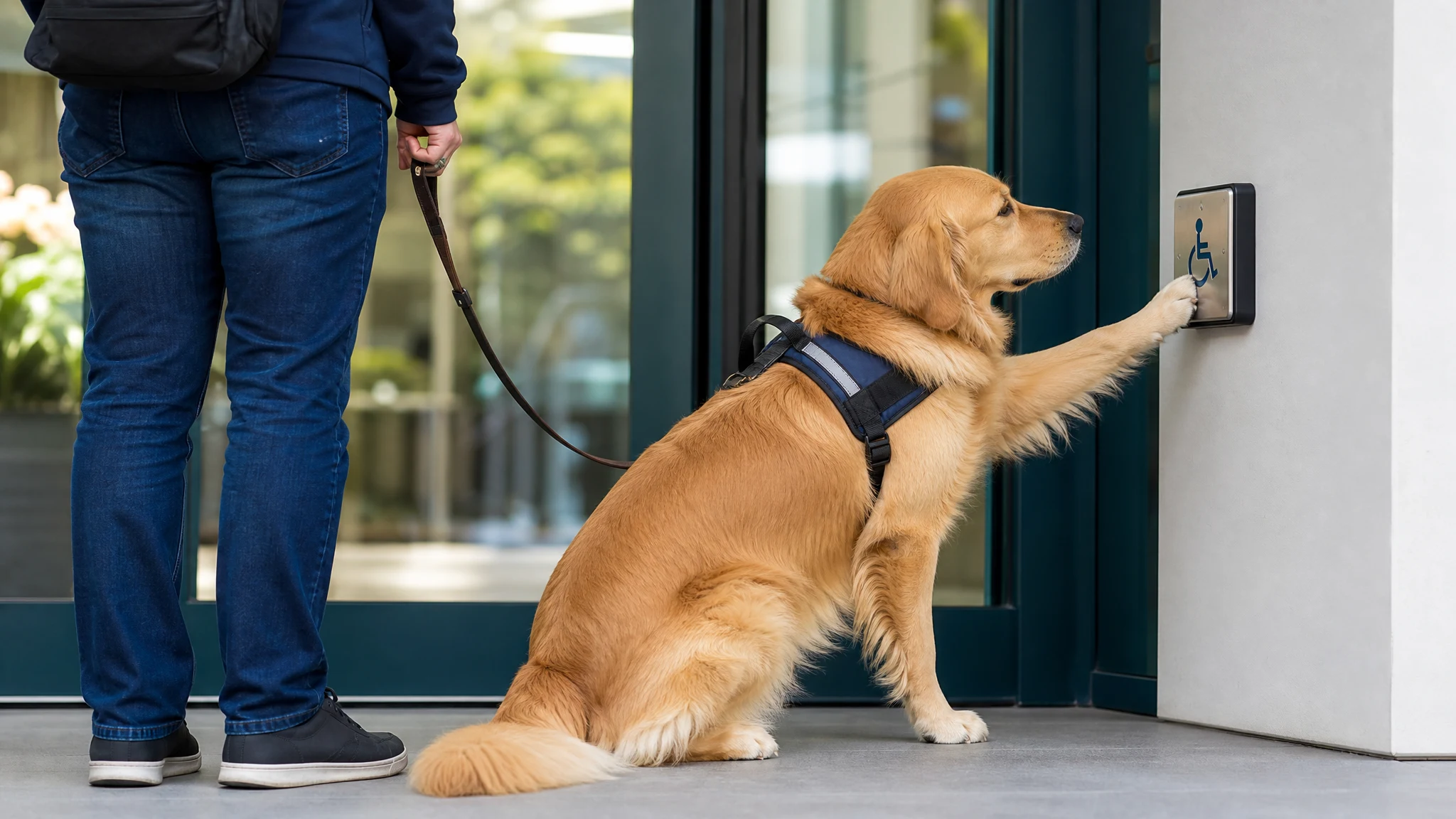
- Opening and closing doors or drawers with a tug strap.
- Providing counterbalance or bracing support while the handler stands.
- Pulling a manual wheelchair for short stretches.
Hearing and vision disabilities
- Alerting a deaf handler to a smoke alarm, a doorbell or a name being called.
- Guiding a blind handler around obstacles and stopping at curbs and stairs.
Medical conditions
- Alerting to a change linked to a condition such as diabetes, and bringing medication or a kit.
- Responding to a seizure by staying close, pressing an alert device or fetching help.
- Alerting to a drop in blood pressure for a handler who faints.
Psychiatric and neurological disabilities
- Interrupting repetitive or self-harming behaviors with a trained nudge or paw touch.
- Applying deep pressure on cue during a panic attack or flashback.
- Checking a room or turning on lights for a handler with PTSD.
- Waking a handler from a nightmare.
- Helping an autistic handler stay grounded, or blocking and covering in crowds.
Several Utah organizations train dogs for these needs. Canines With a Cause in Holladay serves veterans with PTSD, TBI or MST. Loving Angel Service Dogs lists mobility, diabetic alert, PTSD and autism among its areas. Service Paws, based in Layton according to outside coverage, serves people with disabilities, veterans and first responders. Costs and waitlists were not confirmed, so contact each group directly for current details.
Why Comfort Alone Is Not a Task
Many people feel calmer around their dogs. That is real and valuable, but under the ADA it is not enough on its own. Emotional support, therapy and comfort animals are not service animals under the ADA, because simply being present is not trained work.
A simple test helps: could the dog do this on cue or in response to a specific trigger, and would it still be a learned behavior if a stranger watched it? Interrupting a panic spiral with deep pressure is a task. Being a soothing companion is not.
Utah law recognizes a separate category. Under HB0043 (2019), a support animal is an animal other than a service animal that qualifies as a reasonable accommodation under federal law. That category matters mainly for housing. It does not carry the same public access rights as a service dog.
The Public Access Test Is a Benchmark, Not a Legal Requirement
A service dog public access test is a structured check of whether a dog stays calm, controlled and unobtrusive in public places. Assistance Dogs International (ADI) publishes a widely used standard of this kind. Many trainers and programs use ADI's test, or something like it, as a training goal.
It is important to be exact here. The ADA does not require a service dog to pass a public access test. ADA.gov says nothing about a required test, certificate or registry. The ADA also has no official certification or registration. A certificate or ID card from an online seller is not legal proof of anything, and this guide does not recommend buying one.
So why use a test at all? Because the ADA lets a business remove a dog that is out of control or not housebroken. Utah's statute also says the right of access does not apply if the animal is a danger or nuisance to others, as interpreted under the ADA. A dog that passes a rigorous public access test is much less likely to cause that kind of problem.
ADI's current test items and scoring change over time. Check with ADI directly for the latest version instead of relying on a summary, including this one.
Materials You Will Need
- A flat buckle collar or a well-fitted harness, plus a standard six-foot leash.
- A treat pouch with small, soft, high-value treats, and a few lower-value ones.
- A mat or small blanket for settle practice.
- A training journal or notes app to log sessions, setbacks and progress.
- Props for your specific tasks, such as a tug strap, a retrieve item or a medication pouch.
- A clicker or a consistent marker word, if you like using one.
- Access to a range of locations, from quiet to busy, with permission where required.
Step-by-Step: Training Tasks and Preparing for Public Access
Step 1: Name the disability-related need
Start with the problem, not the trick. Write down the specific limitation you want help with, such as "I cannot bend to pick up dropped items" or "I freeze during panic attacks." Each task should answer a need on that list.
Step 2: Build foundation behaviors
Before any task, teach the basics with rewards: sit, down, stay, come, loose-leash walking and settle on a mat. These behaviors make every later step easier. Keep sessions short, five to ten minutes, and end while the dog is still keen.
Step 3: Teach each task in small pieces
Break the task into tiny steps and reward each one. For a retrieve, you might first reward looking at the item, then touching it, then mouthing it, then carrying it, then handing it over. Add a cue only after the behavior is reliable. For alerts, reward the dog for noticing the trigger, then for the trained response.
Step 4: Make the task reliable across places
Dogs do not generalize well. A retrieve learned in the living room may fall apart in a parking lot. Repeat the task in new rooms, then outdoors, then in quiet public spaces. Raise the difficulty one factor at a time: distance, distraction or duration.
Step 5: Practice public manners separately
Public access skills are different from task skills. Work on a calm walk through doorways, ignoring dropped food, settling under a table, staying quiet, and ignoring other dogs and people. Reward the behavior you want, and keep the dog's stress level in view. If the dog shows stress signs, such as heavy panting, lip licking or avoiding, make the setting easier.
Step 6: Use a public access test as a checkpoint
Once the basics hold up in real settings, run through a public access test with a trainer or a knowledgeable helper. Treat it like a practice exam. Note what fell apart and train that piece again, then retest. The goal is a clear picture of readiness, not a pass or fail grade that means anything legally.
Step 7: Know the access rules and the questions you may be asked
When it is not obvious that a dog is a service animal, staff may ask only two questions, according to ADA.gov: whether the dog is a service animal required because of a disability, and what work or task the dog has been trained to perform. Practice a calm, short answer. Staff may not demand paperwork or a demonstration.
For the Utah side, including training, access rights and where they apply, see our guide to service dogs in Utah.
Utah Notes Worth Knowing
- Dogs in training. Under HB0043 (2019), a person who does not have a disability may be accompanied by an animal in training to become a service animal in the same public places, without extra charge. The text opened set no age, harness or ID conditions. The trainer is liable for damage the animal causes to the premises. Confirm current wording on le.utah.gov.
- Charges and damage. A handler with a disability may not be charged extra for the animal, but is liable for damage the animal causes.
- No state ID or registry. No Utah service dog ID or registry turned up in the research behind this article. Check with the Utah Labor Commission if you hear otherwise.
- Misrepresentation. Under HB0043 (2019), knowingly and intentionally claiming an animal is a service animal or support animal when it is not is a class C misdemeanor. Denying or interfering with a person's rights under the chapter is also a class C misdemeanor.
- Housing. The Utah Labor Commission says assistance animals must be permitted despite no-pet rules and should not carry pet deposits or fees.
If you believe you were denied housing or employment because of a service dog, the Utah Labor Commission's Utah Antidiscrimination and Labor Division (UALD) handles those complaints. Its Fair Housing Unit is at 160 East 300 South, 3rd Floor, Salt Lake City, UT 84114-6600, phone (801) 530-6800. Employment charges must be filed within 180 days. A separate agency for public access complaints was not confirmed, so ask the Labor Commission where to start.
Tips for Better Training
- Keep every session positive. Humane, reward-based training is consistent with the American Veterinary Society of Animal Behavior (AVSAB) position. Shock, prong and choke collars, alpha rolls and scruffing do not belong in service dog training.
- Train one task at a time until it is dependable.
- Rest days matter. A tired or overwhelmed dog makes more mistakes.
- Film short clips of your sessions. Watching them back often shows small problems you missed in the moment.
- Work with a qualified trainer if you can, especially for medical alerts and psychiatric tasks.
- Plan the dog's retirement and downtime. Not every dog wants or is suited to this work, and that is a fair outcome.
Common Mistakes to Avoid
- Calling comfort a task. Being calming is not the same as trained work. Teach something specific.
- Buying a registration or certificate. The ADA has no official registry or certification, and these products are not legal proof.
- Treating the public access test as the law. It is a benchmark. Your rights do not depend on passing it.
- Rushing into busy places. Skipping the quiet, mid-level steps often leads to setbacks.
- Overcorrecting mistakes. Harsh reactions can damage trust and make the dog less reliable.
- Ignoring the dog's welfare. Fear, stress and fatigue hurt both the dog and the work.
Expected Results
Results vary with the dog's temperament, age, health, the task and how often you practice. With steady, reward-based work, many handlers find that foundation behaviors become reliable within weeks to months, while complex tasks and public polish often take considerably longer. Some dogs may not suit service work, and that is normal.
A public access test may help you see where a dog is ready and where it needs more work. It may also help you feel more confident in public. It cannot promise that every outing will go smoothly or that every business will respond well.